

Table of Contents
- How Lion's Mane Supports Focus and Everyday Energy
- Lion's Mane Dosage for Cognition: What People Commonly Take
- When to Take Lion's Mane and How Long Results May Take
- Lion's Mane vs Caffeine for Productivity
- Fruiting Body vs Mycelium Supplements: What's the Difference
- How to Take Lion's Mane for Best Results
- Who Should Be Cautious With Lion's Mane
- Conclusion
- Frequently Asked Questions
Last Updated: October 1, 2026
How Lion's Mane Supports Focus and Everyday Energy
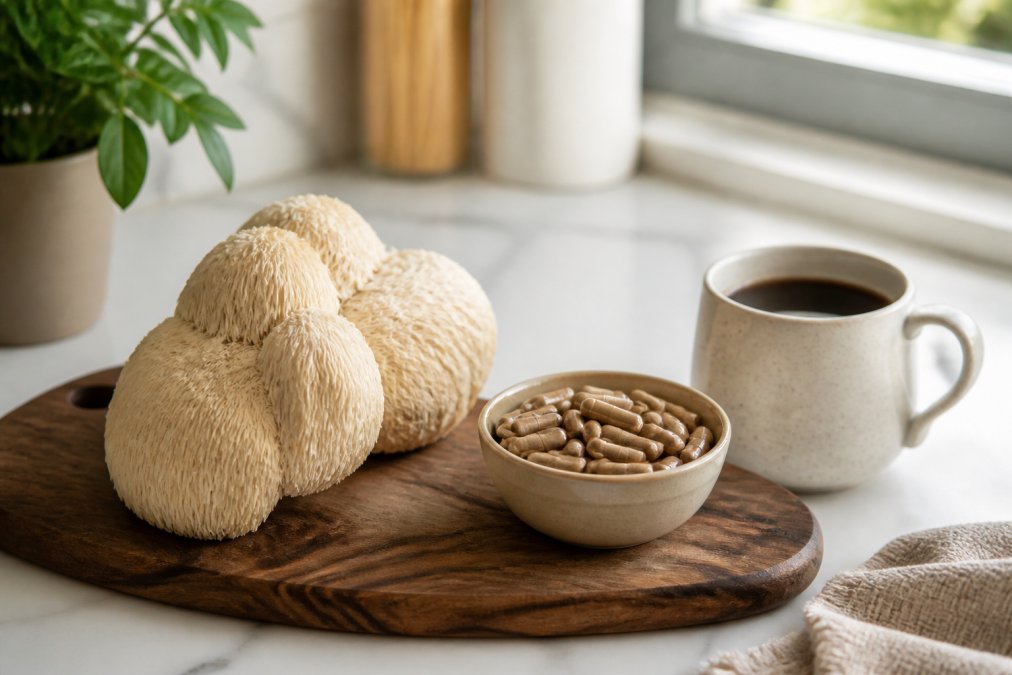
Lion's Mane for focus and energy is one of the most searched functional mushroom topics, and the honest answer is more nuanced than most marketing pages admit: this mushroom is not a stimulant, and it does not work like caffeine. What it is, according to the National Center for Complementary and Integrative Health's overview of mushroom supplements, is a culinary and medicinal mushroom whose extracts have been studied for their effects on nerve growth and cognitive function, though much of that research remains preliminary.

What the Research Suggests (and What It Doesn't)
Most human studies on Lion's Mane are small, short, and preliminary, which means anyone promising dramatic cognitive results is overselling the evidence. Some research points to compounds called hericenones and erinacines that may stimulate nerve growth factor, a protein involved in the maintenance of brain cells. Early trials in older adults have looked at measures of memory and mental clarity, with mixed results.
Lion's Mane Dosage for Cognition: What People Commonly Take
Lion's Mane dosage for cognition is one of the most confusing parts of the category, because the number on the label can mean very different things depending on how the product was made. There is no officially established daily dose, and human trials have used a range of preparations rather than a single standardized extract. What most commercial products and practitioners converge on is roughly 500 mg to 3,000 mg of extract per day, but that range only makes sense once you understand what you are actually counting.

Extract Ratio vs. Actual Compound Content
A "10:1 extract" means ten parts of raw dried mushroom were used to produce one part of finished extract. That sounds impressive, but the ratio alone tells you almost nothing about potency, because it does not say how much of the finished powder is beta-glucans, hericenones, or erinacines versus residual starch and filler. Two products can both say "10:1" and deliver very different amounts of the compounds researchers actually study.
A Practical Framework
- Start low. Many people begin around 500 mg of extract per day for the first week or two to see how they respond.
- Work up gradually. If you tolerate it well, moving toward 1,000-2,000 mg per day is a common middle ground. Some people go higher, but there is no strong evidence that more is meaningfully better.
- Split larger doses. If you are taking more than about 1,000 mg, dividing it between morning and early afternoon is a common pattern.
- Take it with food if you notice any stomach sensitivity, which some people report on an empty stomach.
- Match the dose to the format. A capsule delivering a concentrated extract is not equivalent milligram-for-milligram to a spoonful of raw powder stirred into coffee, because the raw powder contains far more inert material by weight.
Why the Label Matters More Than the Number
For readers who want a defined starting point, Spora's Organic Lion's Mane Capsules list their fruiting body extract and beta-glucan content on the label, which makes it easier to hold a consistent daily serving while you evaluate how you feel over several weeks.
When to Take Lion's Mane and How Long Results May Take
Taking Lion's Mane in the morning or early afternoon is the most common approach, since some people find it mildly alerting and prefer to avoid it close to bedtime. As for timing of results, this is where expectations need calibrating. Some users report noticing subtle changes in focus within a few days, while others say it takes several weeks of consistent use to judge whether it helps.
Lion's Mane vs Caffeine for Productivity
Lion's Mane and caffeine work through entirely different mechanisms, and understanding that difference is the key to using either well. Caffeine blocks adenosine receptors to reduce the feeling of tiredness, producing a fast, noticeable lift that fades within hours. Lion's Mane is not a stimulant; it does not spike alertness, and it does not cause a crash. Instead, it is often described as supporting steady mental clarity over time.
Can You Combine Them?
Combining them is common and generally well tolerated by most healthy adults, though anyone sensitive to caffeine should keep their usual limits in mind. A typical pattern is coffee in the morning for immediate alertness and Lion's Mane taken alongside it or shortly after for longer-term support. If you are already drinking several cups of coffee daily to get through a stressful job, Lion's Mane is unlikely to replace that caffeine hit, but some people find it helps them feel less reliant on constant top-ups over time.
Fruiting Body vs Mycelium Supplements: What's the Difference
The fruiting body is the actual mushroom you would see growing above ground, while mycelium is the root-like network it grows from, often cultivated on grain. Many budget supplements use mycelium grown on grain and list "mushroom" on the label, which means a meaningful portion of the product by weight may be grain starch rather than fungal material. Fruiting body extracts tend to carry higher concentrations of the beta-glucans and other bioactive compounds researchers focus on, which is why label transparency matters so much here.
How to Take Lion's Mane for Best Results
How to take Lion's Mane for best results comes down to three things: consistency, quality, and realistic expectations. Take it at the same time each day, choose an extract you can verify, and give it several weeks before drawing conclusions. Capsules are the simplest option; powders mix into coffee or smoothies for anyone who dislikes swallowing pills.
Organic Lion’s Mane Capsules for Focus →
What to Look for in a Quality Supplement
- Fruiting body, not mycelium, listed clearly on the label
- Beta-glucan content stated as a percentage or milligram amount
- Third-party lab testing for purity and contaminants
- Organic certification you can verify
- No unnecessary fillers or proprietary blends that hide doses
For readers who want a straightforward starting point, Spora's Organic Lion's Mane Capsules use 100% organic fruiting body extract with naturally occurring beta-glucans, are vegan and non-GMO, and are lab-tested for purity. If stress is part of why focus feels difficult, the Lion's Mane and Ashwagandha bundle pairs the two in one routine.
Who Should Be Cautious With Lion's Mane
Lion's Mane is generally well tolerated, but it is not right for everyone without a conversation with a healthcare provider. People taking blood-thinning medication, blood pressure medication, or immunosuppressants should check first, since interactions have not been thoroughly studied. Anyone with a mushroom allergy should avoid it. Those who are pregnant, nursing, or managing a diagnosed condition should treat it as a decision to make with their doctor rather than on their own.
MedlinePlus consumer information on herbal and dietary supplements
Conclusion
The gap between what Lion's Mane is marketed as and what the research currently supports is wide, and closing that gap honestly is the whole point of this guide. Lion's Mane is not a stimulant and will not feel like a shot of espresso, but for people looking for steady support for focus and mental clarity as part of a consistent routine, it is a reasonable addition worth evaluating over several weeks.
Frequently Asked Questions
Is Lion's Mane a stimulant like caffeine?
No. Lion's Mane is not a stimulant. It does not work by blocking adenosine receptors or raising heart rate the way caffeine does. People who take Lion's Mane for focus and energy typically describe a steadier sense of mental clarity rather than a jolt. If you need an immediate alertness boost, caffeine works faster, but it also comes with a crash for many people. Lion's Mane is usually taken daily as part of a routine, not as a quick pick-me-up before a deadline.
How long does it take for Lion's Mane to work for focus?
It varies. Some people report noticing differences within a few days, while others say it takes several weeks of consistent daily use. Research on Lion's Mane and cognition has generally looked at longer periods of daily intake rather than single doses, so short-term expectations should stay modest. The most common approach is to take it daily for at least four to eight weeks before deciding whether it fits your routine. Consistency matters more than timing.
Can I take Lion's Mane every day for mental clarity?
Many people do take Lion's Mane daily, and it is commonly used as a routine supplement rather than a one-off. There is no widely established need to cycle it, though some people prefer to take breaks. If you take prescription medication, have a health condition, or are pregnant or breastfeeding, talk to a healthcare provider first. Keep track of how you feel over several weeks rather than judging it day by day.
What should I look for in a high-quality Lion's Mane supplement?
Look for the fruiting body listed as the source, not mycelium grown on grain. Check that the label states beta-glucan content or shows a standardized extract. Third-party lab testing for purity and heavy metals is a good sign. Spora's Organic Lion's Mane Capsules use organic fruiting body extract and are lab-tested for purity and quality, which is the kind of transparency worth looking for across any brand you consider.
Are there any side effects of taking Lion's Mane?
Lion's Mane is generally well tolerated in the amounts commonly used. Some people report mild digestive discomfort when starting. Because it may affect immune activity, people with autoimmune conditions or those taking immunosuppressant medications should speak with a healthcare provider before using it. If you notice any unusual reaction, stop and consult a professional. Do not use it to replace prescribed treatment for any diagnosed condition.
Does Lion's Mane replace coffee for productivity?
Not exactly. Caffeine provides fast, short-term alertness; Lion's Mane is taken daily and is associated with support for mental clarity over time. Many people keep both in their routine, using coffee when they need an immediate lift and Lion's Mane as a consistent background support. If caffeine makes you jittery, Lion's Mane may be a gentler option to try, but it will not feel like a cup of coffee.


