

Table of Contents
- What Separates a Quality Mushroom Supplement From the Rest
- How to Choose a Mushroom Supplement: A Scored Buying Rubric
- Fruiting Body vs. Mycelium: Why the Label Word Changes Everything
- Beta-Glucan Testing and the Label Math Most Buyers Miss
- Mushroom Supplement Third-Party Testing: How to Verify a COA Yourself
-
Mushroom Supplement Benefits: What Human Research Suggests, Species by Species
- Lion's Mane (Hericium erinaceus), Small Human Studies
- Reishi (Ganoderma lucidum), Small Human Studies
- Cordyceps, Small Human Studies
- Turkey Tail (Trametes versicolor), Human Clinical Trials
- Chaga (Inonotus obliquus), Preliminary Research
- Maitake (Grifola frondosa), Preliminary Research
- Agaricus blazei, Preliminary Research
- How to Read a Benefit Claim
- Cost Per Serving, Format, and Who Should Be Careful
- Conclusion: Build Your Own Shortlist
- Frequently Asked Questions
Last Updated: October 12, 2026
What Separates a Quality Mushroom Supplement From the Rest
A quality mushroom supplement is made from identified species, processed to preserve its natural compounds, tested by an independent lab, and labeled honestly.
The functional mushroom category has grown quickly, and labeling standards have not kept pace.
That gap matters. A product built on mycelium-and-grain biomass behaves very differently from one built on pure fruiting body extract, even when both bottles say "Lion's Mane" in large type.

The Four Signals That Actually Matter
Four things predict quality better than any marketing claim: the part of the mushroom used, the extraction method, the beta-glucan content, and independent testing. Species identity matters too, but it is the easiest of the five to fake on a label.
Everything else, including capsule color, bottle design, and the word "premium," is decoration.
What Labels Do Not Tell You
A front label can legally say "mushroom extract" while the contents are mostly mycelium grown on grain. It can say "organic" without naming a certifier, or print a large "extract ratio" that says nothing about how much extract is in the capsule. The back panel is where the real information lives: the supplement facts panel, the ingredient list, and a batch-specific lab report.
How to Choose a Mushroom Supplement: A Scored Buying Rubric
Learning how to choose a mushroom supplement gets easier with a scoring sheet. Score each candidate against five weighted criteria and let the total decide, capsule, powder, or liquid extract.
Scoring Sheet: Five Criteria, 100 Points
| Criterion | What to Check | Points |
|---|---|---|
| Fruiting body source | Label names fruiting body, not just "mushroom" or "mycelium" | 25 |
| Beta-glucan disclosure | States beta-glucan content per serving on the label | 20 |
| Third-party testing | Publishes a batch-specific certificate of analysis | 20 |
| Ingredient purity | No unnecessary fillers, flow agents, or grain residue | 20 |
| Species and extract clarity | Names the species and the extraction method | 15 |
A product scoring 80 or above is worth buying. Anything under 60 usually means the manufacturer is hoping you won't read the back panel.
Fruiting Body vs. Mycelium: Why the Label Word Changes Everything
Fruiting body is the actual mushroom you would recognize, the stem and cap that grows above ground. Mycelium is the root-like network beneath it, usually grown commercially on a grain substrate such as rice or oats.
Shop Spora builds its formulas around organic fruiting body extract and skips grain fillers entirely, so the beta-glucan figures on the label reflect mushroom compounds rather than grain starch.
Beta-Glucan Testing and the Label Math Most Buyers Miss
Beta-glucans are the polysaccharides most often linked to mushroom research, and the compound quality-focused brands standardize around. A bottle might advertise "1,000 mg mushroom extract" per serving, but that tells you the weight of the powder, not how much of it is beta-glucan. That serving could contain 50 mg of beta-glucans or 300 mg, depending on the raw material and the extraction.
Total Polysaccharides vs. Beta-Glucans
The most common label trick is printing "polysaccharides" and letting the reader assume it means beta-glucans. It does not. Total polysaccharides include beta-glucans plus starch, glycogen, chitin fragments, and other carbohydrates, on a mycelium-and-grain product, a large share can be grain starch. "30% polysaccharides" and "30% beta-glucans" are not the same claim; only the second tells you how much of the researched compound is present.
How Beta-Glucans Are Actually Measured
Labs do not use one universal test. Two methods show up most often on certificates of analysis:
- The Megazyme enzyme-based method isolates beta-glucans specifically and reports them as a percentage. This is the more informative result because it excludes starch.
- The total glucan method can include other glucans and may overstate the beta-glucan figure.
A COA that names the assay method is more trustworthy than one that just prints a percentage. If the method is not stated, ask.
The Label Math, Step by Step
The fix is simple arithmetic, done in the right order.
- Find the beta-glucan figure on the label, a percentage ("25% beta-glucans") or milligrams per serving ("250 mg beta-glucans").
- If it is a percentage, multiply by the extract weight per serving. A 1,000 mg serving at 25% beta-glucans gives you roughly 250 mg of beta-glucans.
- If two products use different serving sizes, normalize to a common amount. A product with 200 mg beta-glucans per 500 mg capsule is 40% beta-glucans; one with 300 mg per 1,500 mg scoop is 20%. The first is more concentrated even though the second has a bigger absolute number.
- Divide the price by the beta-glucan milligrams per serving to get cost per effective serving. That figure, not the bottle price, is what makes two products comparable.
What a Good Beta-Glucan Label Looks Like
A transparent label states the beta-glucan content per serving in milligrams or as a percentage, names the species, and specifies fruiting body. It does not hide behind "polysaccharides" or an extract ratio. If you can do the division in under a minute, the brand gives you enough to work with; if you cannot find the number at all, that is the answer.
Mushroom Supplement Third-Party Testing: How to Verify a COA Yourself
Third-party testing means an independent laboratory, not the manufacturer, analyzed the finished product for identity, purity, and potency.
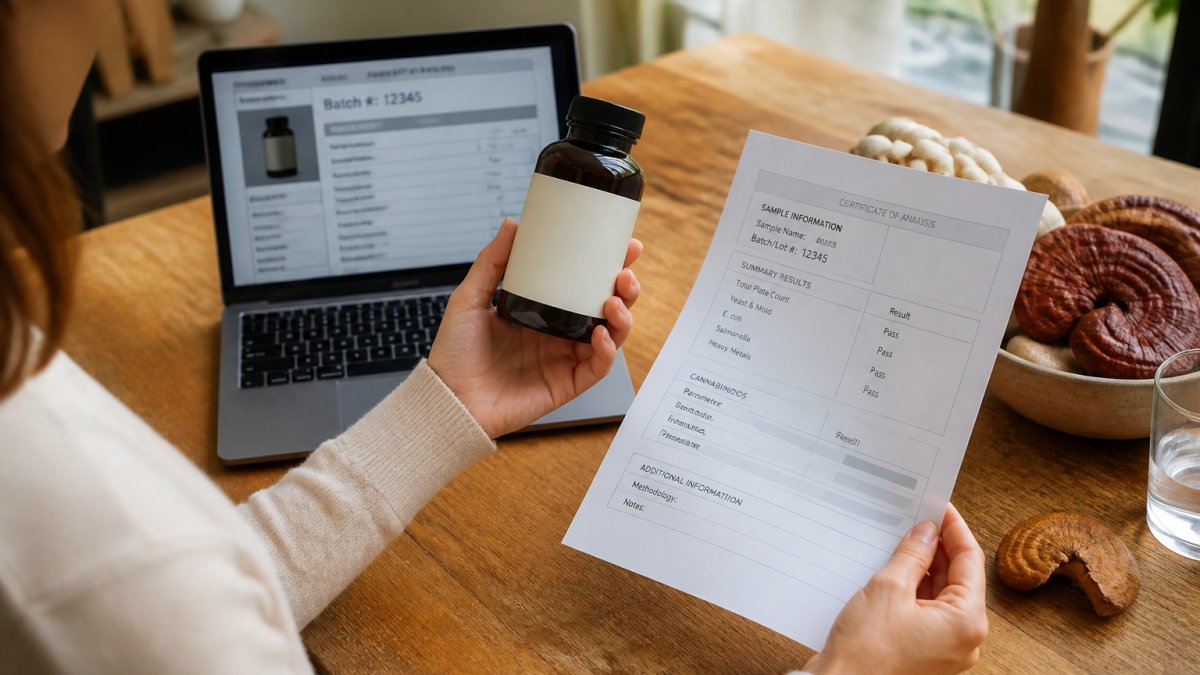
Verification takes about five minutes if you know what to look for. Guidance from the FDA on dietary supplement labeling confirms that manufacturers are responsible for the identity and purity of what they sell, which is exactly why independent verification exists as a separate check.
Run through this checklist for any COA you receive:
- The lot or batch number matches the bottle in your hand
- The testing laboratory is named and is not the manufacturer
- Heavy metals, including lead, arsenic, cadmium, and mercury, are reported
If a company publishes a COA for a different lot than yours, the document proves nothing about your bottle. That single mismatch is the most common weakness in supplement transparency.
Organic Lion’s Mane Capsules for Focus & Clarity →
Mushroom Supplement Benefits: What Human Research Suggests, Species by Species
Mushroom supplement benefits vary by species, and evidence quality varies too. Some species have small human trials behind them; others rest almost entirely on laboratory and animal work. Neither category supports a promise, but the distinction is worth knowing before you buy. Below, each species is tagged by the strongest evidence tier currently available: human clinical trials, small or preliminary human studies, or traditional and laboratory research only.
Lion's Mane (Hericium erinaceus), Small Human Studies
Lion's Mane has drawn interest for cognitive function and mental clarity. A handful of small human trials have looked at older adults with mild cognitive concerns and at healthy adults, but sample sizes are small and results are mixed. Shop Spora's Lion's Mane capsules are made from organic fruiting body extract with naturally occurring beta-glucans.
Reishi (Ganoderma lucidum), Small Human Studies
Reishi is traditionally associated with calm and immune support. Most human research uses concentrated extracts in smaller trials, and some studies look at quality-of-life measures rather than hard clinical endpoints. The traditional-use record is long; the modern clinical record is thin.
Cordyceps, Small Human Studies
Cordyceps is studied mainly for energy and physical performance, with athletes forming much of the participant pool. Results are modest and inconsistent across trials. Note that most commercial cordyceps is Cordyceps militaris or fermented Cordyceps sinensis, not the wild-harvested form used in older research, so study results do not always transfer to the bottle in front of you.
Turkey Tail (Trametes versicolor), Human Clinical Trials
Turkey Tail has the most clinical attention of any species, largely in supportive-care settings where it is studied alongside standard medical treatment, never as a replacement for it. These studies examine adjunct use, not standalone treatment, a distinction worth understanding before drawing conclusions.
Chaga (Inonotus obliquus), Preliminary Research
Chaga appears mostly in laboratory and animal studies, with very little human clinical data. It is traditionally used as a tea or decoction. Realistic expectations should stay modest, and wild-harvested Chaga raises sustainability concerns because the fungus grows slowly.
Maitake (Grifola frondosa), Preliminary Research
Maitake has been studied in small human trials, often alongside standard care, but the evidence base is not large enough to support broad claims. It is traditionally used in cooking and as a food-based preparation.
Agaricus blazei, Preliminary Research
Agaricus blazei appears mostly in preliminary research, often in laboratory settings. Human data is limited. As with Chaga and Maitake, the honest framing is "under study," not "proven."
How to Read a Benefit Claim
A NIH Office of Dietary Supplements overview is a reasonable starting point for checking what human clinical trials actually exist for a given species. Three questions separate a defensible claim from marketing:
- Does the claim name the species, or does it treat "mushrooms" as one interchangeable category?
- Does it distinguish human trials from laboratory and animal work?
- Does it describe a realistic effect size, or does it promise a dramatic shift?
If a brand claims a benefit no trial supports, that tells you something about the brand.
Cost Per Serving, Format, and Who Should Be Careful
Price per bottle is close to meaningless.
Format matters for consistency as much as cost. Shop Spora also offers a Lion’s Mane & Ashwagandha Wellness Bundle that includes Ashwagandha Gummies for anyone who prefers a chewable format alongside a capsule.

A few cautions apply regardless of format:
- Medication interactions. Mushroom extracts can interact with blood thinners, immunosuppressants, and diabetes medication. Anyone taking prescription drugs should talk to a pharmacist or physician first.
- Autoimmune conditions. Immune-supporting species warrant a conversation with a clinician before regular use.
- Surgery. Stop new supplements in advance of any scheduled procedure and confirm timing with the surgical team.
Side effects reported in the literature tend to be mild, often digestive, and usually fade.
Conclusion: Build Your Own Shortlist
The supplement aisle rewards patience and punishes impulse. Score candidates on the five criteria, verify the COA for your exact lot, and calculate cost per effective serving before you commit to a bottle.
Shop Spora publishes batch-specific testing, uses organic fruiting body extract with no grain fillers, and states beta-glucan content on the label, which makes the verification steps in this guide straightforward. Start with the Lion's Mane Cognition capsules if focus and mental clarity are the goal, or browse the full range at Shop Spora to build a routine that fits your day.
Frequently Asked Questions
What should I look for in a mushroom supplement?
Check four things on the label. First, whether it lists fruiting body or mycelium. Second, whether it states beta-glucan content rather than a vague polysaccharide number. Third, whether the brand publishes a certificate of analysis from a third-party lab. Fourth, whether the ingredient list is short enough that you recognize each item. If a label hides any of these, treat it as a reason to keep looking.
Is mushroom fruiting body extract better than mycelium?
They are different ingredients, not grades of the same one. Fruiting body is the mushroom itself. Mycelium is usually grown on grain, and the dried product can contain a large share of grain starch, which is why some mycelium labels report high polysaccharides without much beta-glucan. If you want the part traditional use and most human research focused on, fruiting body extract is the more direct choice.
How long does it take to notice effects from mushroom supplements?
There is no reliable timeline, and anyone promising one is guessing. Human trials on species like Lion's Mane have run for weeks, not days, so short experiments tell you little. A practical approach is to pick one product, take it consistently at the labeled serving size for several weeks, and track sleep, focus, and stress in a simple note. If nothing changes and the label math does not hold up, stop buying it.
Are mushroom supplements scientifically proven?
Some species have human clinical trials, but the evidence is preliminary rather than settled. Reishi, Lion's Mane, Cordyceps, and Turkey Tail have all been studied in people, often in small trials or alongside conventional care. That supports cautious interest, not certainty. It also means a quality mushroom supplement should be judged on what is verifiably in the bottle, not on the strength of a health claim.


