

Table of Contents
- What Defines a High-Quality Mushroom Supplement Brand
- Fruiting Body vs Mycelium Mushroom Supplements: What You're Actually Buying
- Mushroom Supplement Third-Party Testing and Verification
- How to Read Mushroom Supplement Labels for Transparency
- Mushroom Coffee vs Mushroom Supplements: Which Format Works Best
- Matching Your Goals to the Right Mushroom Species and Brand
- Frequently Asked Questions
Last Updated: October 7, 2026
What Defines a High-Quality Mushroom Supplement Brand
A high-quality mushroom supplement brand prioritizes transparency about what's in the bottle. Three factors separate premium products from mediocre ones: source material (fruiting body versus mycelium), third-party purity verification, and honest labeling.
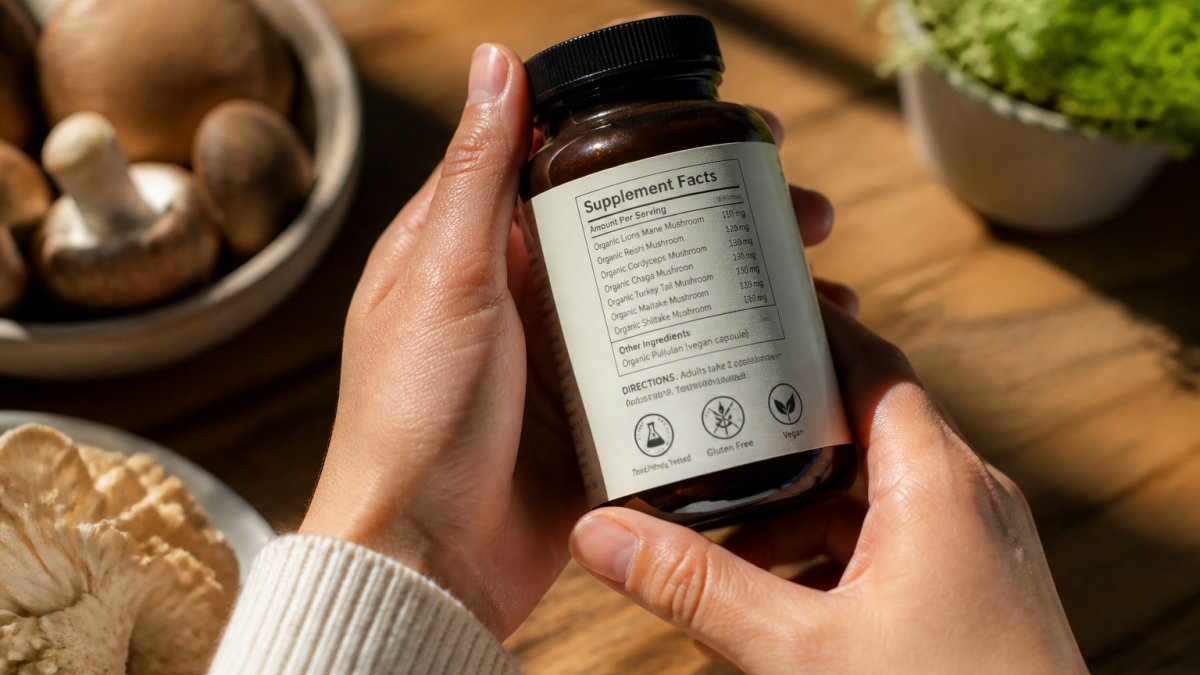
When evaluating a mushroom supplement brand, look for disclosed sourcing practices, clear dosage information, and independent testing.
Shop Spora represents this transparency-first approach, using only mushroom fruiting bodies without grain fillers, with each product lab-tested for purity and quality.
The best brand depends on your goals, cognitive support, immune function, energy, or stress management, and your format preference: capsules, powder, or mushroom coffee.
Fruiting Body vs Mycelium Mushroom Supplements: What You're Actually Buying
This distinction matters because the two have different compositions. Fruiting bodies typically contain higher concentrations of beta-glucans and polysaccharides, the compounds associated with mushroom health benefits.
Many budget-friendly mushroom supplements use mycelium grown on grain because it's cheaper to produce. The label might say "mushroom extract," but the fine print often reveals grain makes up a significant portion of the final product.
Shop Spora uses only fruiting body extract, meaning no grain fillers and no ambiguity about what you're consuming.
When shopping for a mushroom supplement brand, check the label for these phrases:
- "Fruiting body extract" or "fruiting body mushroom", a stronger indicator of quality
- "Mycelium on grain" or "grain-based", indicates a lower potency product
- "Mushroom extract ratio" (e.g., 8:1 or 10:1), shows how concentrated the extract is
- Vague terms like "mushroom blend" or "proprietary formula", a red flag for unclear sourcing
Mushroom Supplement Third-Party Testing and Verification
Third-party testing is one of the few ways to verify that a mushroom supplement brand delivers what its label promises. The key word is independent: the lab should have no financial relationship with the seller. A brand testing its own material in its own facility is not third-party testing.
The document that proves testing happened is a Certificate of Analysis (COA). A useful COA identifies the lot number, names the laboratory, lists test methods, and reports actual measured results, not just a pass/fail stamp.
What a COA Should Actually Test For
| Test category | What it verifies | Why it matters |
|---|---|---|
| Identity | That the material is the species named on the label (e.g., Hericium erinaceus for Lion's Mane) | Prevents substitution with cheaper look-alike species or filler |
| Beta-glucan content | The percentage of beta-glucans, a key polysaccharide fraction in mushrooms | Beta-glucans are the compound most often tied to mushroom research; a product with low beta-glucans may not reflect the material studied |
| Heavy metals | Levels of lead, arsenic, cadmium, and mercury | Mushrooms can absorb metals from soil and substrate, so this is a meaningful purity check |
| Microbials | Total plate count, yeast, mold, E. coli, Salmonella | Confirms the product isn't contaminated during processing or storage |
| Pesticides and residual solvents | Agricultural chemicals and extraction solvents | Relevant for extracts, which use solvents to concentrate compounds |
Some labs also test for ergothioneine or triterpenes (compounds associated with Reishi), but these are less standardized. If a brand highlights one, ask what method was used and whether the result is reported per serving.

How to Tell Independent Testing From Marketing
A common pattern is a brand claiming "third-party tested" with no documentation. Here's how to separate the two:
- Ask for the COA by lot number. A real testing program can produce a document tied to the specific batch you bought. A generic PDF with no lot number is weaker evidence.
- Check who performed the test. The lab should be named. Many reputable labs are ISO 17025 accredited, which means their methods and equipment meet an internationally recognized standard.
- Look for the test date. A COA from three years ago doesn't tell you anything about the bottle in your hand.
- Compare the result to the label claim. If the label says 30% beta-glucans and the COA reports 12%, that's a discrepancy worth questioning.
Where Spora Fits
Shop Spora products are lab-tested for purity and quality, and the brand's approach is to make that information available rather than bury it in marketing language. This aligns with what informed buyers increasingly expect: a fruiting-body extract with a documented testing trail, not just a "lab-tested" badge. You can review the current lineup at Shop Spora's supplement collection.
One caveat: a clean COA confirms identity, purity, and potency, not that the product will produce a specific health outcome. Testing and efficacy are separate questions.
How to Read Mushroom Supplement Labels for Transparency
Mushroom species: The label should name the specific mushroom, Lion's Mane, Reishi, Cordyceps, Chaga, or Turkey Tail.
Extract ratio: This number (like 8:1 or 10:1) indicates how much raw mushroom was used.
Active compounds: Look for beta-glucan content listed as a percentage. This is the primary compound associated with mushroom health benefits.
Ingredient list: Fillers, binders, and additives should be minimal and clearly listed. A long list of unfamiliar ingredients is worth investigating.
Certifications: Look for organic certification, non-GMO verification, or vegan certification if those matter to you.
Organic Lion’s Mane Capsules for Focus & Clarity →
Mushroom Coffee vs Mushroom Supplements: Which Format Works Best
Mushroom coffee blends mushroom extract with regular coffee, offering convenience for coffee drinkers. Mushroom supplements, capsules, powders, or gummies, provide more dosage control and let you choose specific species.
Mushroom coffee advantages:
- Easy to integrate into an existing morning routine
- Familiar taste and ritual
- No additional step required
- Good for casual users exploring mushroom wellness
Mushroom supplements advantages:
- Precise dosage control
- Ability to target specific mushroom species for specific goals
- No caffeine if you prefer (many mushroom supplements contain none)
- Easier to adjust serving size or take multiple species
- Better for people sensitive to caffeine
The choice depends on your lifestyle and goals. Someone seeking cognitive support might prefer a Lion's Mane capsule for precise dosing, while a coffee lover might start with a mushroom coffee blend.
FDA guidance on dietary supplement labeling
Format also matters for consistency: a capsule with breakfast is easier to remember than a powder you mix, and mushroom coffee works for those with an existing coffee habit.
Matching Your Goals to the Right Mushroom Species and Brand
Different mushroom species have different traditional uses and levels of research. Choosing the right species for your goals matters more than picking the most popular brand, and understanding how preliminary the evidence is matters more than either.
Species, Traditional Use, and Where the Evidence Stands
The table below separates traditional use (long-standing cultural practice, often centuries old) from preliminary research (early human studies, small trials, or mechanistic work that has not been confirmed in large trials). None of these categories means a supplement diagnoses, treats, cures, or prevents any disease.
| Species | Traditional association | State of the evidence |
|---|---|---|
| Lion's Mane (Hericium erinaceus) | Cognitive support, focus, nerve health | Preliminary, small human studies and animal research have looked at mood and cognition, but results are not established and larger trials are needed |
| Reishi (Ganoderma lucidum) | Relaxation, stress support, general wellness | Preliminary, studied for immune and stress-related markers, mostly in small or early-stage trials |
| Cordyceps (Cordyceps militaris, Ophiocordyceps sinensis) | Energy, physical endurance | Preliminary, some small studies in exercise performance, but findings are mixed and not definitive |
| Chaga (Inonotus obliquus) | Antioxidant support, general wellness | Early-stage, mostly laboratory and animal work; human data is limited |
| Turkey Tail (Trametes versicolor) | Immune support | Preliminary, studied as a complementary approach in some clinical settings, but not a treatment for any condition |
| Maitake (Grifola frondosa) | General wellness, metabolic support | Early-stage, some small human studies, but evidence is not strong enough to make specific claims |
A useful rule of thumb: the more confident a brand's claim sounds, the more skeptical you should be. "Traditionally used for focus" is honest; "clinically proven to boost memory" is not supported by current evidence for any mushroom supplement.
Safety, Interactions, and Who Should Ask a Clinician First
Mushroom supplements are generally well tolerated, but "natural" does not mean "risk-free." A few practical points:
- Medication interactions. Some mushrooms, particularly Reishi and Turkey Tail, may interact with blood thinners, immunosuppressants, or diabetes medications. If you take prescription medication, check with a healthcare provider before adding a mushroom supplement.
- Allergies. People with mushroom or mold allergies may react to supplements, especially to mycelium-based products that contain grain substrate.
- Pregnancy and breastfeeding. There is not enough reliable data on most mushroom supplements in pregnancy or lactation. The conservative approach is to avoid them unless a clinician says otherwise.
- Surgery. Some practitioners recommend pausing immune-supporting mushrooms in the weeks before surgery. Ask your care team.
- Autoimmune conditions. Because some mushrooms are studied for immune effects, people with autoimmune conditions should get medical guidance before use.
A Reproducible Checklist for Comparing Brands
Rather than ranking brands by popularity, use the same criteria across every product you consider, making comparisons like-for-like.
- Species named specifically (e.g., Hericium erinaceus), not "mushroom blend"
- Part used disclosed, fruiting body, mycelium, or both
- Substrate disclosed if mycelium is used (grain, rice, etc.)
- Extract ratio stated (e.g., 8:1) or a standardized extract percentage given
- Beta-glucan content listed as a percentage or per serving
- Serving size and daily dose clear, how many capsules or grams per serving, and how many servings per container
- COA available by lot number with identity, potency, heavy metals, and microbial results
- Certifications verifiable, organic, non-GMO, vegan, or third-party seals that can be checked
- Price per effective serving calculated, not just price per bottle
- Claims match the evidence, traditional-use language rather than disease or cure claims
That last item is the one most buyers skip. A brand that says "supports focus" is making a structure/function claim that's allowed for dietary supplements under FDA labeling rules. A brand that says a product "treats ADHD" or "cures fatigue" has crossed into drug claims, which is a red flag about the company's overall approach. For the official framework, see FDA guidance on dietary supplement labeling.
Applying the Checklist
Once you've identified your goal and the species that aligns with it, run the product through the checklist above. A few examples:
- Focus and cognitive support: Look for Lion's Mane fruiting-body extract with disclosed beta-glucan content. Lion's Mane Cognition 100% Organic is formulated for focus and clarity using fruiting body extract with naturally occurring beta-glucans.
- Stress and relaxation support: Reishi is the traditional choice; check that the label names the species and discloses the part used. For those pairing stress support with cognitive goals, Ashwagandha Gummies 100% Organic offers another complementary adaptogenic option.
- Energy and endurance: Cordyceps products vary widely in quality; verify extract ratio and beta-glucan content before comparing.
- Stacked goals: Some buyers pair species for complementary support across multiple wellness areas.
A quality mushroom supplement brand makes it easy to answer every question on that checklist. If a brand's marketing focuses on hype rather than disclosure, keep looking.
Frequently Asked Questions
What is the difference between mushroom fruiting body and mycelium supplements?
Fruiting body supplements use the actual mushroom structure, which contains higher concentrations of active compounds like beta-glucans and polysaccharides. Mycelium supplements use the root-like network grown on grain substrates, which often contains more filler material.
How can you tell whether a mushroom supplement is high quality?
Look for brands that disclose their source (fruiting body vs mycelium), provide third-party testing results, list the mushroom species clearly, and include extract ratios or beta-glucan content on the label. Reputable brands share transparency about sourcing and manufacturing. Check for organic certification if that matters to you, and verify the company's reputation through customer feedback and ingredient sourcing practices.
Are mushroom supplements healthy?
Functional mushrooms contain compounds like beta-glucans and polysaccharides that have been studied for potential wellness benefits. However, supplements are not intended to diagnose, treat, cure, or prevent disease. If you take medications or have health concerns, consult a healthcare provider before starting any supplement, as some mushroom species may interact with certain medications.
Which is better, mushroom supplements or mushroom coffee?
Both formats offer functional mushroom compounds, but they serve different needs. Mushroom coffee blends provide a convenient way to incorporate mushrooms into your morning routine and may offer a smoother caffeine experience. Supplements in capsule or powder form allow precise dosing and are easier to take consistently without the coffee flavor. Your choice depends on whether you prefer integrated convenience or standalone supplementation.


