

Table of Contents
- What Brain Fog Actually Feels Like and What Causes It
- Why Lion's Mane Is the Most Studied Mushroom for Cognition
- Lion's Mane Supplement Benefits: What the Evidence Supports (and What It Doesn't)
- Lion's Mane Dosage: What Human Studies Have Used
- Mushroom Coffee for Focus: Does It Compare to a Capsule?
- What to Look for in an Organic Mushroom Supplement
- Mushroom Supplement Safety: Interactions, Side Effects, and Who Should Skip Them
- Conclusion: Realistic Expectations for Organic Mushroom Supplements for Brain Fog
- Frequently Asked Questions
Last Updated: October 9, 2026
What Brain Fog Actually Feels Like and What Causes It
Brain fog is not a medical diagnosis but a set of symptoms: difficulty concentrating, slower recall, mental fatigue, and the feeling that thoughts move through syrup. This guide covers what may drive those symptoms, why Lion's Mane has become the most discussed mushroom for cognition, and how to judge whether organic mushroom supplements for brain fog are worth trying.

The honest answer up front: no supplement is a proven fix for brain fog. The evidence for Lion's Mane is early and far from settled.
Common Causes: Sleep, Stress, Nutrition, and Lifestyle
Most brain fog traces back to something fixable rather than a deficiency.
- Sleep debt: Short or fragmented sleep degrades attention and working memory first.
- Chronic stress: Sustained cortisol exposure disrupts focus and makes recall feel effortful.
- Blood sugar swings: Skipped meals and heavy caffeine cycles produce energy crashes that read as fog.
When Brain Fog Warrants a Doctor's Visit
Fog that arrives suddenly, worsens steadily, or comes with confusion, word-finding trouble, or personality changes deserves medical evaluation rather than a supplement. The same applies if it interferes with daily function or follows a head injury. A clinician can rule out thyroid dysfunction, vitamin deficiencies, sleep disorders, and other treatable causes.
Why Lion's Mane Is the Most Studied Mushroom for Cognition
Lion's Mane (Hericium erinaceus) is the functional mushroom researchers return to most often in cognitive studies. It is an edible mushroom with a long culinary history, and it contains compounds that have shown neurotrophic activity in laboratory work.

That distinction matters. Lab findings are not the same as human outcomes.
What Hericenones and Erinacines Do in Early Research
Hericenones, found in the fruiting body, and erinacines, found in the mycelium, are the two compound families most studied in Lion's Mane.
Whether that translates to measurable cognitive benefit in people is an open question. NGF activity in a petri dish does not automatically mean better memory in a human brain.
National Center for Complementary and Integrative Health overview of mushroom supplements
Lion's Mane Supplement Benefits: What the Evidence Supports (and What It Doesn't)
Small human trials have explored Lion's Mane for cognitive function, and results have been mixed.
What the evidence does not support is any claim that Lion's Mane treats, cures, or prevents brain fog, dementia, or mild cognitive impairment. Those are medical conditions, and no supplement is approved for them.
A reasonable framing: Lion's Mane is a well-tolerated functional mushroom with preliminary cognitive research behind it.
Lion's Mane Dosage: What Human Studies Have Used
There is no established official dosage for Lion's Mane, and no daily value exists. Human studies reporting cognitive outcomes have generally used fruiting body or mycelium extracts in the range of roughly 250 mg to 3,000 mg per day, taken orally, often for 8 to 16 weeks.
That range is wide because the studies were small, used different extracts at different concentrations, and measured different things. A trial using a concentrated fruiting body extract is not directly comparable to one using mycelium powder, even if the milligram numbers look similar.
Why the Range Is So Wide
Three factors explain most of the spread:
- Extract concentration. A 500 mg dose of a 10:1 extract represents far more raw mushroom than 500 mg of dried powder. Milligrams alone do not capture that difference.
- Fruiting body versus mycelium. The two contain different compound profiles, so studies using one are not interchangeable with studies using the other.
- Study design. Small sample sizes, short durations, and varied cognitive tests make it hard to isolate a dose-response relationship.
Practical Guidance on Serving Size and Timing
Since the research does not settle on a dose, the label becomes your reference point:
- Follow the label first. Product directions reflect the concentration of that specific extract. Do not assume a higher milligram count is automatically better.
- Consistency beats intensity. Daily use over weeks is how the trials were structured. Taking a large amount occasionally is not the same pattern the research followed.
- Timing is flexible. Lion's Mane is not a stimulant, so it does not need to be taken in the morning the way caffeine does. Many people take it with a meal to reduce the chance of stomach upset, and some prefer morning simply because it is easier to remember.
How Long Before You Can Assess It
In human trials that reported changes, participants typically took Lion's Mane daily for at least 8 weeks, and some studies ran to 12 or 16 weeks. Give a product a consistent 8-week window rather than judging it after a few days.
Because the evidence is preliminary and mixed, a fair assessment is whether the product fits your routine comfortably and whether you notice any subjective difference, not whether it produces a dramatic cognitive shift.
Mushroom Coffee for Focus: Does It Compare to a Capsule?
Mushroom coffee and capsules deliver Lion's Mane very differently.
A standardized capsule delivers a measured, consistent amount of extract without caffeine. For someone trying to isolate whether Lion's Mane does anything for them, a capsule removes the caffeine variable.
Organic Lion’s Mane Capsules for Focus & Clarity →
| Format | Typical Lion's Mane Amount | Caffeine | Best For |
|---|---|---|---|
| Capsule | Measured extract per serving | None | Consistent daily dosing |
| Mushroom coffee | Small, varies by blend | Yes | Replacing a regular coffee |
| Powder | Varies by scoop | Depends on blend | Flexible dosing, smoothies |
| Tincture | Concentrated liquid drops | None | Those who dislike capsules |
Neither format is "better" in the abstract. A capsule suits someone who wants a repeatable dose; mushroom coffee suits someone who wants to swap one habit for another.
What to Look for in an Organic Mushroom Supplement
Label literacy separates a useful product from an expensive powder. Because the keyword here is organic, the first job is learning to verify that word rather than trust it. Four things are worth checking before buying any organic mushroom supplement.
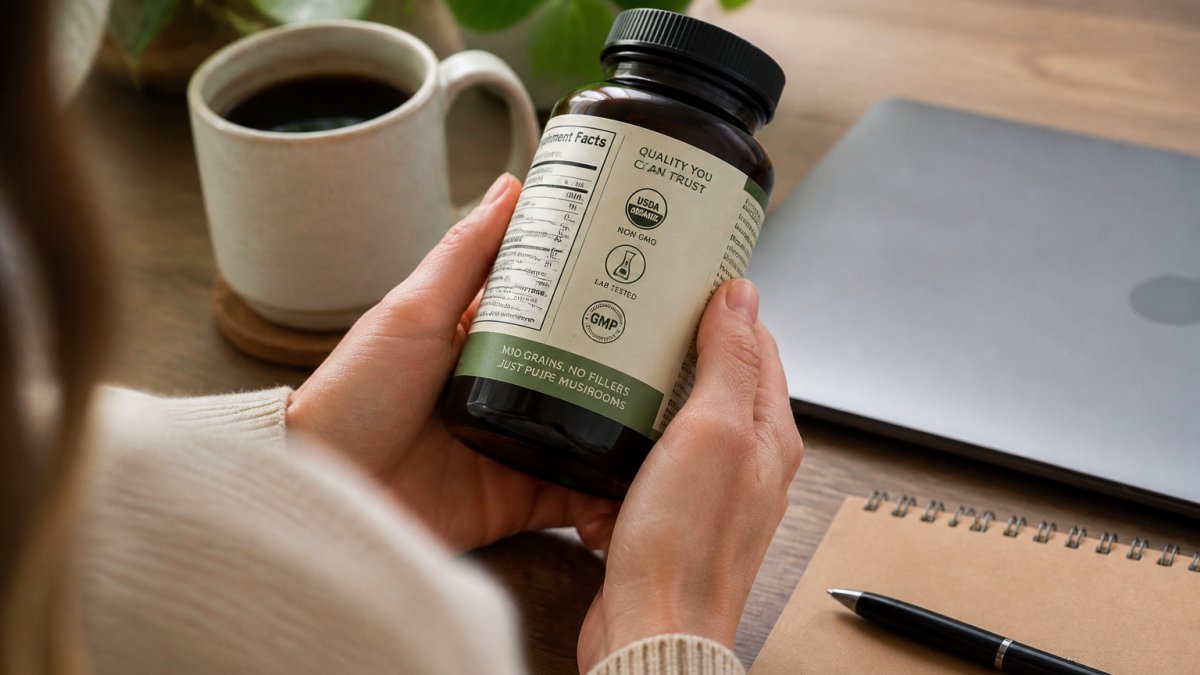
Certification, Extract Quality, and Label Literacy
1. Verified organic certification. In the United States, "organic" on a dietary supplement is a regulated term, not a marketing adjective.
2. Fruiting body versus mycelium. This is the most common source of confusion on mushroom labels.
3. Beta-glucan content. Beta-glucans are among the polysaccharides researchers measure when assessing mushroom extract quality, and they are more meaningful than total mushroom weight.
4. Third-party testing. Purity testing for heavy metals, pesticides, and microbial contamination is the difference between a claim and a verification.
How to Read a Supplement Facts Panel
The Supplement Facts panel is where transparency either shows up or doesn't. A few patterns are worth knowing:
- Proprietary blends. If the panel lists a "proprietary blend" with a single total milligram amount, you cannot tell how much Lion's Mane is actually in the product versus other ingredients. A panel that lists each extract separately is more useful.
- Extract ratio. A notation like 8:1 or 10:1 describes how much raw material went into the extract. Higher ratios generally indicate a more concentrated extract, though the ratio alone does not tell you the beta-glucan content.
- "Other ingredients." This line covers fillers, flow agents, and capsules. Fewer, recognizable ingredients are usually a sign of a simpler formula.
Dosage and Product Labeling
There is no official daily value for Lion's Mane, so the label is your starting reference. Product directions reflect the concentration of that specific extract, which is why two 500 mg capsules from different brands are not interchangeable. A label stating the extract type, the mushroom part used, the beta-glucan content, and clear serving directions gives you enough to compare.
Spora's Lion's Mane capsules use organic fruiting body extract, are lab-tested for purity and quality, and are vegan and non-GMO. You can review the Spora Lion's Mane Cognition product page for the full ingredient and testing details. If you prefer a calming adaptogen alongside your mushroom routine, Spora also offers Ashwagandha Gummies, though stress support is a separate goal from cognitive support.
Mushroom Supplement Safety: Interactions, Side Effects, and Who Should Skip Them
Mushroom supplements are generally well tolerated in studies so far, with reported side effects in human trials tending to be mild and gastrointestinal. That is not the same as risk-free.
Who should talk to a clinician first:
- Anyone taking blood thinners, immunosuppressants, diabetes medication, or blood pressure medication
- People with autoimmune conditions
- Anyone scheduled for surgery
Lion's Mane may affect platelet function and immune activity in ways that matter for some medications. Because supplement-drug interaction research is limited, the safe move is asking a pharmacist or physician before starting, especially if you take prescription medication.
Conclusion: Realistic Expectations for Organic Mushroom Supplements for Brain Fog
The honest position on organic mushroom supplements for brain fog: they are a reasonable wellness addition with early, inconclusive research behind them, and they are not a treatment.
What supports focus more reliably than any capsule is sleep, stress management, nutrition, and a doctor's visit when symptoms are new or worsening.
U.S. Food and Drug Administration guidance on dietary supplement labeling
Frequently Asked Questions
Can Lion's Mane help with brain fog?
Early human studies suggest Lion's Mane may support cognitive function, but the evidence is still limited and no supplement is proven to treat brain fog. A small trial in older adults found modest improvements in cognitive test scores after 12 weeks, while other studies showed mixed results. Brain fog often stems from poor sleep, stress, or nutritional gaps, so addressing those factors matters too. Lion's Mane is best viewed as one part of a broader wellness routine, not a standalone fix.
How long does it take for Lion's Mane supplements to work?
Most human studies that reported cognitive changes used daily Lion's Mane for 8 to 16 weeks before measuring outcomes. Some users notice subtle shifts in focus within a few weeks, but patience matters. If you have taken a consistent Lion's Mane dosage for two to three months and notice nothing, that is useful information. Keep a simple log of your sleep, stress, and focus to see whether any changes track with the supplement rather than other factors.
Is Lion's Mane supplement better than mushroom coffee for focus?
They serve different purposes. Mushroom coffee for focus typically combines coffee with small amounts of mushroom extract, so most of the alertness comes from caffeine. A dedicated Lion's Mane capsule delivers a standardized extract amount without caffeine, which suits people who are sensitive to stimulants or already drink several cups of coffee. If you want a caffeine-free option with a consistent serving size, a capsule is easier to measure than a blended coffee drink.
What should I look for in an organic mushroom supplement?
Check for verified organic certification on the label, not just the word organic in the product name. Look for fruiting body extract rather than mycelium grown on grain, since mycelium products can be mostly starch. Confirm the label states beta-glucan content and mentions third-party testing for purity. Also check the serving size and whether the extract ratio is disclosed. Spora's Lion's Mane capsules, for example, list organic fruiting body extract and lab testing on the product page.
Brain fog has many causes, and no single supplement addresses all of them. For readers who want to add a functional mushroom to an existing routine, Shop Spora offers organic Lion's Mane Cognition made with fruiting body extract, lab-tested for purity, and formulated without grain fillers. Pair it with the Lion's Mane and Ashwagandha bundle if stress support matters alongside focus. Explore the Spora range and build a routine that fits your day.


