

Table of Contents
- What the Research Actually Shows About Mushroom Supplements
- Lion's Mane Cognitive Benefits Research: What Studies Reveal
- Other Functional Mushrooms: Evidence by Species
- Fruiting Body vs. Mycelium Supplements: What Makes the Difference
- How to Choose High-Quality Mushroom Supplements
- Mushroom Supplement Dosage Guidelines and Safety
- The Bottom Line: Evidence-Based Expectations
- Frequently Asked Questions
Last Updated: October 5, 2026
What the Research Actually Shows About Mushroom Supplements
The question of whether mushroom supplements are scientifically proven doesn't have a simple yes-or-no answer. The reality is far more nuanced.
Mushroom supplements scientifically proven to work for specific purposes remain a growing area of investigation. Some species show genuine promise in human clinical trials, while others rely primarily on preclinical research, studies conducted in test tubes or animal models that haven't yet been validated in people. This distinction matters enormously when evaluating whether a mushroom supplement is worth your time and money.
The challenge for consumers is that marketing often blurs this line. A compound that shows potential in a petri dish gets presented with the same confidence as one tested in hundreds of humans. Understanding what "scientifically proven" actually means in this context is essential before investing in any mushroom supplement regimen.
Lion's Mane Cognitive Benefits Research: What Studies Reveal
Lion's Mane (Hericium erinaceus) represents the most thoroughly studied functional mushroom for cognitive function. This species has attracted serious scientific attention because early research suggested it might support nerve growth factor (NGF) production, a protein involved in brain cell growth and maintenance.

The research landscape for Lion's Mane breaks into two distinct categories: preclinical findings and human clinical evidence. Preclinical studies, primarily conducted in laboratories and animal models, have documented bioactive compounds in Lion's Mane that demonstrate biological activity. These findings generated legitimate scientific interest and motivated human trials.
Human Clinical Evidence vs. Preclinical Studies
The gap between preclinical research and human clinical evidence represents the most important distinction when evaluating mushroom supplements scientifically proven claims. Preclinical research establishes that something could work. Human clinical trials determine whether it actually does work in real people, at real dosages, over meaningful timeframes.
Several human studies on Lion's Mane and cognitive function have been published in peer-reviewed journals. These trials generally involved smaller sample sizes than pharmaceutical studies and measured outcomes like cognitive function, mood, and quality of life. Results have been mixed but generally supportive of further investigation.
The distinction matters because a promising preclinical finding doesn't guarantee clinical benefit. Many compounds show activity in laboratory settings but fail to translate into human effectiveness due to absorption issues, dosage limitations, or other biological factors.
Study Limitations and What Researchers Still Don't Know
Current research on Lion's Mane and other functional mushrooms carries significant limitations that honest scientists readily acknowledge. Sample sizes in human trials tend to be modest. Study durations vary widely, from weeks to several months, making it difficult to assess long-term effects.
Publication bias also plays a role. Studies showing positive results are more likely to be published than neutral or negative findings, which can skew the overall perception of evidence strength. Additionally, many studies originate from regions where supplement regulation differs substantially from the framework in the United States, which can affect how findings are interpreted.
Researchers continue investigating optimal dosages, extraction methods, and which populations might benefit most from Lion's Mane supplementation. The current evidence base supports further investigation but stops short of conclusive proof that Lion's Mane supplements universally improve cognitive function across all users.
Other Functional Mushrooms: Evidence by Species
Reishi, Cordyceps, Turkey Tail, and Chaga
Beyond Lion's Mane, several other functional mushrooms have attracted research attention, though the evidence profiles differ substantially. Reishi mushroom has been studied for its potential effects on stress response and sleep quality.
Cordyceps represents another species with both traditional use and emerging scientific interest. This mushroom has been investigated for potential effects on physical performance and energy metabolism.
Turkey Tail mushroom contains substantial amounts of polysaccharides, particularly beta-glucans, which have been studied for immune system effects.
Chaga mushroom has generated interest for its antioxidant properties, though human clinical trials are scarce. Most evidence comes from laboratory studies examining the mushroom's chemical composition and activity in controlled settings.
The pattern across these species is consistent: promising preclinical research and traditional use documentation exist, but human clinical evidence proving efficacy remains incomplete. This doesn't mean these mushrooms lack value, it means the scientific validation process is ongoing.
Fruiting Body vs. Mycelium Supplements: What Makes the Difference
The distinction between fruiting body and mycelium supplements fundamentally affects what you're purchasing and its potential potency. The fruiting body is the visible mushroom structure, the part you'd recognize in a forest or on a dinner plate.
Fruiting body supplements contain the concentrated compounds that developed as the mushroom matured. These typically include higher concentrations of beta-glucans and other bioactive polysaccharides that have been the focus of most clinical research.
This matters because most published research on functional mushrooms has used fruiting body extracts or concentrated fruiting body preparations.
Quality mushroom supplement manufacturers typically specify whether their products contain fruiting body, mycelium, or a combination. Transparency about this detail signals a company that understands the difference and is being honest about what they're selling.
How to Choose High-Quality Mushroom Supplements
Selecting a quality mushroom supplement requires attention to several specific factors that directly impact what you're actually consuming. The difference between a well-formulated product and a mediocre one often comes down to details that most consumers never examine.
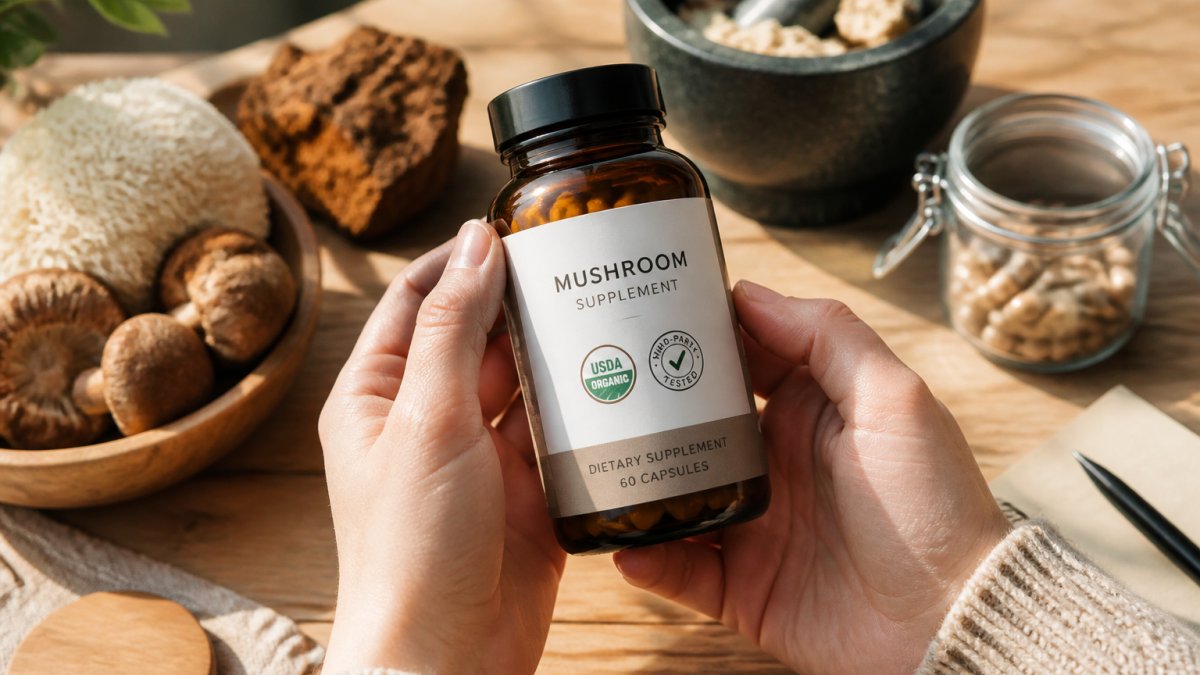
Start with the source material. As discussed above, fruiting body extracts generally align better with published research than mycelium-on-grain products. Look for manufacturers who clearly state what part of the mushroom they're using and whether the product contains grain fillers.
Extraction method affects bioavailability and potency. Hot water extraction and dual extraction (combining water and alcohol) are common methods that help concentrate bioactive compounds like beta-glucans and polysaccharides. The extraction process should be documented on the product label or the company website.
Dosage transparency matters significantly. Reputable manufacturers specify exactly how many milligrams of active mushroom extract appear in each serving.
Organic Lion’s Mane Capsules for Focus & Clarity →
Testing, Transparency, and Third-Party Verification
Third-party testing represents one of the most important quality signals available to consumers. Independent laboratories can verify that a product actually contains what the label claims and that it's free from contaminants like heavy metals or mold.
Look for companies that test for potency (verifying beta-glucan content and other active compounds), purity (confirming the absence of contaminants), and identity (confirming the product actually contains the mushroom species claimed).
Transparency about sourcing and manufacturing location is another quality indicator. Companies willing to disclose where mushrooms are grown and how products are manufactured demonstrate confidence in their supply chain. If a manufacturer is evasive about these details, that's a warning sign.
Quality manufacturers exemplify this approach to assurance. Their mushroom supplements use only fruiting body extracts without grain fillers, and products are lab-tested for purity and quality.
Mushroom Supplement Dosage Guidelines and Safety
Determining an appropriate dosage for mushroom supplements requires understanding both what research suggests and individual variation in response. Most human studies on functional mushrooms have used dosage ranges that varied considerably depending on the specific mushroom, extraction method, and intended benefit.
For Lion's Mane, studies examining cognitive effects have typically used dosages ranging from several hundred milligrams to a few grams daily of the mushroom extract. Duration of use in these studies ranged from weeks to several months. Starting with a lower dose and observing your response over several weeks provides a practical approach to finding what works for your individual situation.
Consistency matters more than sporadic high doses. Mushroom supplements appear to work best with regular daily use rather than occasional consumption. This makes sense given that many of the proposed mechanisms involve gradual biological changes rather than acute effects.
Interactions and Who Should Seek Medical Advice
Mushroom supplements generally have a favorable safety profile, but interactions and contraindications do exist.
Individuals with mushroom allergies should obviously avoid mushroom supplements. Those with compromised immune systems or taking immunosuppressive medications for organ transplants should discuss mushroom supplementation with their medical team, since some functional mushrooms are traditionally used to support immune function.
Pregnant and nursing individuals should consult healthcare providers before starting any new supplement, including mushroom products. The safety profile during pregnancy and lactation hasn't been extensively studied for most functional mushrooms.
If you're currently on prescription medications or have chronic health conditions, a conversation with your doctor or pharmacist before starting mushroom supplements represents prudent decision-making. This isn't because mushroom supplements are inherently dangerous, it's because individual health situations vary, and potential interactions deserve professional evaluation.
The Bottom Line: Evidence-Based Expectations
Mushroom supplements scientifically proven to work represent a more complex reality than marketing suggests. Some functional mushrooms, particularly Lion's Mane, have genuine human clinical evidence supporting potential cognitive benefits, though this evidence remains preliminary compared to pharmaceutical standards.
The honest assessment is that functional mushrooms represent an area of active scientific investigation rather than settled science.
For readers interested in exploring Lion's Mane specifically, the National Institutes of Health maintains research databases on medicinal mushrooms where you can review published studies directly.
The most evidence-based approach involves selecting high-quality supplements from manufacturers committed to transparency and testing, maintaining consistent daily use, and observing your own response over several weeks. If you notice benefits, continue.
For those considering adding Lion's Mane to their wellness routine, research from the Journal of Medicinal Food has published several human studies on this species. Additionally, Shop Spora's Organic Lion's Mane Cognition provides a fruiting body extract formulation designed for daily use, offering a practical option for those wanting to explore this mushroom's potential benefits with a product that emphasizes quality and transparency.
The evidence on mushroom supplements continues evolving as researchers conduct more rigorous human clinical trials.
Frequently Asked Questions
Do mushroom supplements actually work?
Mushroom supplements show promise in research, but results vary by species, formulation, and dosage. Lion's Mane has the most human clinical evidence for cognitive support, though studies are still limited. Other mushrooms like Reishi and Turkey Tail show encouraging preliminary findings, but most lack large-scale human trials. Effectiveness depends on product quality, consistent use, and realistic expectations about what supplements can achieve.
Is there scientific evidence for Lion's Mane?
Yes. Several human clinical trials have examined Lion's Mane for cognitive function and focus. Studies show it contains bioactive compounds like beta-glucans that may support brain health. However, human evidence remains limited compared to preclinical research. Most studies involve small participant numbers and short timeframes. The research is promising enough to warrant further investigation, but Lion's Mane is not yet considered clinically proven for specific disease treatment.
What should I look for when buying mushroom supplements?
Choose products made from fruiting body extract rather than mycelium grown on grain, as fruiting bodies contain higher concentrations of active compounds. Verify third-party testing for purity and potency, check for organic certification, and confirm the brand discloses extraction methods and dosage. Transparent labeling and lab reports are signs of quality. Avoid products making disease-treatment claims, and start with established dosages (typically 500-2000 mg daily for Lion's Mane, depending on the product).
Are there risks to taking mushroom supplements?
Mushroom supplements are generally well-tolerated, but some people experience mild digestive upset. More importantly, certain mushrooms may interact with blood thinners, immune-suppressing medications, or diabetes drugs. If you take prescription medications or have an underlying health condition, consult your doctor before starting any supplement. Pregnant or nursing individuals should seek medical guidance. Quality matters: poorly tested products may contain contaminants or mislabeled ingredients.
How do extraction methods affect mushroom supplement quality?
Extraction methods determine how many active compounds (like beta-glucans and polysaccharides) end up in the final product. Hot water extraction is standard for most medicinal mushrooms and effectively releases water-soluble compounds. Dual extraction (hot water plus alcohol) captures a broader range of bioactive ingredients. Products listing extraction ratios (e.g., 10:1) indicate potency. Fruiting body extracts are generally more potent than mycelium products because the fruiting body naturally contains higher concentrations of these active compounds.
How long does it take to notice benefits from mushroom supplements?
Timeline varies by individual and the specific benefit. Some people report improved focus or mental clarity within days of consistent use, while others notice changes over weeks. Most research studies run 4-12 weeks, suggesting that consistent daily use over several weeks is more likely to show results than immediate effects. Factors like dosage, product quality, extraction method, and individual metabolism all influence how quickly you might notice a difference.
Are mushroom supplements scientifically proven to prevent or treat disease?
No. Mushroom supplements cannot legally claim to diagnose, treat, cure, or prevent disease. While research explores potential health applications, clinical validation for specific disease treatment remains limited. Most evidence is preclinical (laboratory or animal studies) or observational. Some human trials show promising results for immune support and cognitive function, but these are not the same as proven disease treatment. Always consult a healthcare provider if you have a diagnosed condition.


