

Table of Contents
- What Purity Actually Means in a Mushroom Supplement
- How to Read Mushroom Supplement Labels
- Fruiting Body vs Mycelium Mushroom Supplements
- Mushroom Supplement Third-Party Testing: What Labs Actually Check
- Reading a Mushroom Supplement Certificate of Analysis
- Organic Certification, GMP, and Sourcing Claims
- 7 Things to Check Before Buying a Mushroom Supplement
- Warning Signs of Low-Quality Mushroom Supplements
- Frequently Asked Questions
Last Updated: October 14, 2026
What Purity Actually Means in a Mushroom Supplement
Purity in a mushroom supplement means the product contains what its label says, in the amount stated, without unwanted fillers or contaminants, which is the standard pure mushroom supplements are held to.
That chain matters because the supplement aisle rewards vague language. A bottle can say "mushroom extract" and still hide grain starch or a blend so small it barely registers.
How to Read Mushroom Supplement Labels
Reading a mushroom supplement label means checking four things: the species name, the part used, the extract ratio, and the full ingredient list.
Start with the species. A quality label names the mushroom in plain terms and in Latin, such as Lion's Mane (Hericium erinaceus) or Reishi (Ganoderma lucidum).
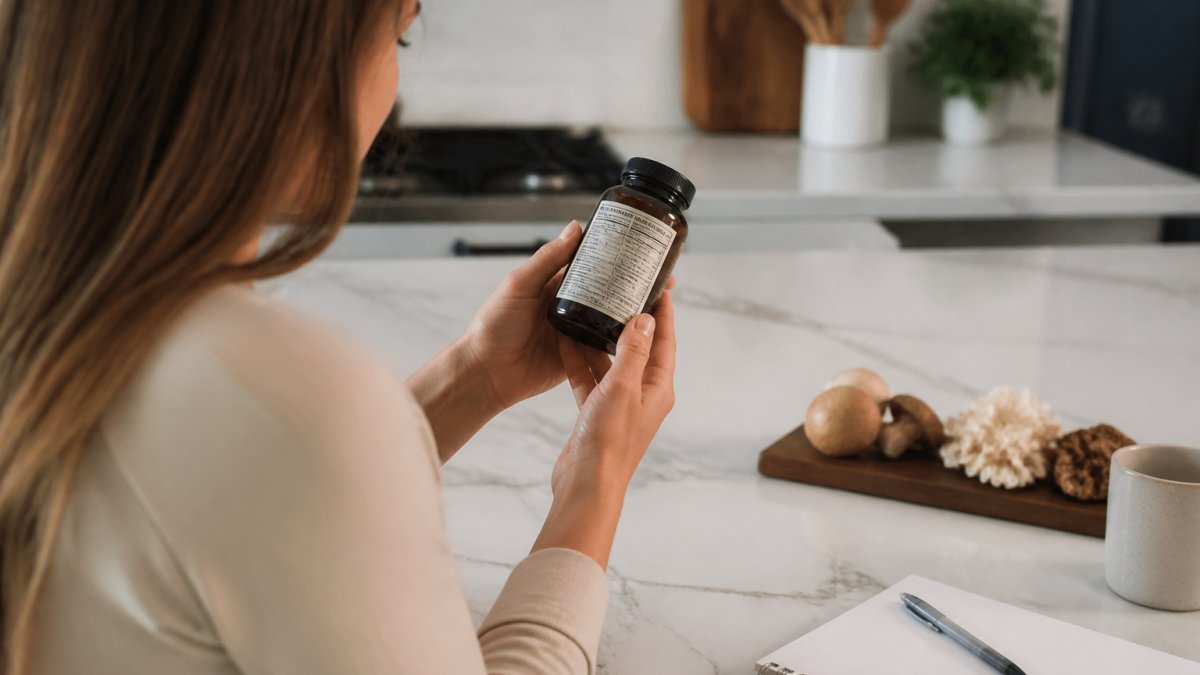
Species Names, Serving Sizes, and Extract Ratios
The serving size tells you how much material one dose delivers. "500 mg per capsule" is only useful if the label also states whether that 500 mg is raw powder or concentrated extract.
An extract ratio shows how much raw mushroom went into the finished extract. A 10:1 ratio means ten parts dried mushroom made one part extract. Higher ratios are not automatically better, but an undisclosed ratio is a real question mark.
Fillers, Flow Agents, and Proprietary Blends
The ingredient list is where fillers hide. Common ones include brown rice flour, maltodextrin, and magnesium stearate. Some serve a manufacturing purpose; others simply add weight.
Watch for two red flags:
- A "proprietary blend" that lists total milligrams but not per-mushroom amounts
- Starch or grain listed before the mushroom itself
A blend can legally hide how little of each mushroom is present, the opposite of transparency.
Fruiting Body vs Mycelium Mushroom Supplements
Fruiting body vs mycelium mushroom supplements is the comparison most buyers ask about, and the honest answer is that quality depends on formulation and testing, not the ingredient type alone. The fruiting body is the above-ground mushroom; mycelium is the root-like network it grows from, often on grain, some of which can end up in the final powder. That does not make mycelium useless, but the label should say what it was grown on.
Whole Mushroom Powder vs Concentrated Extract
Whole mushroom powder is dried and ground mushroom. Concentrated extract is made by pulling compounds out with water, alcohol, or both.
- Whole powder keeps the full material but is bulkier
- Hot water extraction targets water-soluble compounds
- Dual extraction uses water and alcohol to reach a wider range
Neither format is superior by default. What matters is whether the label states which one is inside.
Mushroom Supplement Third-Party Testing: What Labs Actually Check
Mushroom supplement third-party testing means a laboratory outside the brand's control examines a batch for identity and safety. This is where a marketing claim becomes verifiable, but only if you know what each test establishes. Labs typically run several categories, each answering a different question:
- Identity testing confirms the declared species is present, using DNA-based methods such as PCR or chemical fingerprinting such as HPLC or TLC. DNA testing detects whether a species is present or absent but does not measure how much is in the capsule, and it may not distinguish fruiting body from mycelium of the same species. Chemical fingerprinting can help confirm the part used by looking for compounds tied to fruiting bodies versus grain-grown mycelium.
- Beta-glucan testing measures a specific class of compounds found in mushroom cell walls, the number most worth reading closely.
- Heavy metals screening looks for lead, arsenic, cadmium, and mercury, which occur naturally in soil and can concentrate in mushrooms.
Why Beta-Glucans Are Not the Same as Total Polysaccharides
This is the most misunderstood number on a mushroom supplement label. Beta-glucans are a specific type of polysaccharide found in mushroom cell walls and the compound most functional-mushroom research focuses on.
A product can report a very high total polysaccharide figure and still contain very little mushroom-derived beta-glucan.
The fix is to look for the specific assay. A meaningful report names 1,3/1,6 beta-glucans (sometimes written as beta-(1,3)(1,6)-D-glucan) and states the method used, such as the Megazyme enzyme-based assay.
What Contaminant Testing Should Cover
A thorough contaminant panel addresses four categories:
- Heavy metals, lead, arsenic, cadmium, mercury
- Microbials, total plate count, yeast and mold, E. coli, Salmonella, Staphylococcus aureus
- Pesticides, especially relevant for imported material
- Residual solvents, relevant for alcohol-extracted products
Acceptable limits depend on the standard the lab tests against. In the United States, common reference points include USP <2232> for elemental contaminants in dietary supplements and FDA guidance on heavy metals. A COA should state which limit the result was compared against, a number with no benchmark tells you very little.
How to Verify a Testing Claim Independently
"Lab-tested" is easy to print. Verifying it takes about five minutes:
- Get the lab's name. If the brand will not name the laboratory, the claim cannot be checked.
- Check accreditation. Look for ISO/IEC 17025 accreditation, the international standard for testing and calibration laboratories. U.S. accreditation bodies include A2LA and ANSI National Accreditation Board (ANAB), both with searchable directories.
- Confirm the test date and batch number. A report from two years ago does not describe the bottle in your hand.
A brand that names its lab, shares batch-specific reports, and shows the method behind each number is doing the work. A brand offering only a badge is asking you to take its word for it.
Reading a Mushroom Supplement Certificate of Analysis
A mushroom supplement Certificate of Analysis (COA) is a lab report tied to a specific batch, the single most useful document a buyer of pure mushroom supplements can request, because it shows what was tested, how, and with what results. A complete COA should include:
Organic Lion’s Mane Capsules for Focus & Clarity →
- Product name and batch or lot number, ties the report to a specific production run
- Testing laboratory name and accreditation, so you can verify the lab independently
- Date of testing, recent enough to describe the batch you bought
A Step-by-Step COA Verification Workflow
Here is a practical sequence for checking any COA against a product:
- Find the batch number on your bottle. It is usually printed near the expiration date or on the bottom of the container.
- Match it to the COA header. The batch number on the report must match the batch number on your bottle. A report for a different batch proves nothing about your product.
- Check the test date. It should fall within the production window of that batch, not years earlier.
- Verify the lab. Search the lab's name in the A2LA or ANAB accreditation directories to confirm ISO/IEC 17025 status.
- Read the identity result. It should name the species and, ideally, the part tested (fruiting body versus mycelium).
- Read the beta-glucan result. Look for 1,3/1,6 beta-glucans specifically, not total polysaccharides.
- Read the contaminant results against their limits. Each result should show both the measured value and the limit it was compared against.
- Note what is missing. A COA that omits identity testing, or reports only raw material, is a partial picture.
How to Request a COA From a Brand
Requesting a COA is simple, and how a brand responds tells you a lot.
- Find the contact email or form on the brand's site
- Ask for the COA for the exact batch number on your bottle
- Request the lab name and accreditation status
- Ask whether the report covers the finished product or only raw material
- Ask which standard the contaminant limits were compared against
A brand that shares batch-specific reports promptly is showing its work. A brand offering only a generic PDF, or none at all, is asking for trust it has not earned.
What a COA Cannot Tell You
A COA is a snapshot of one batch, not a guarantee about the brand. It does not tell you whether every batch is tested, whether the same lab is used consistently, or whether the product will work for you.
The strongest position is to use the COA alongside the label, certification check, and sourcing information. Each answers a different question, and together they give a fuller picture than any single document.
Organic Certification, GMP, and Sourcing Claims
Organic certification, GMP status, and sourcing claims are useful signals, but none guarantees purity on its own.
Organic certification speaks to how the mushroom was grown. You can check a certificate through the USDA Organic Integrity Database.
GMP refers to Good Manufacturing Practices, the FDA's framework for how supplements are made and handled.
Sourcing transparency means the brand can say where the mushroom came from and how it was grown.
The key point: certifications describe process. They do not replace batch testing.
7 Things to Check Before Buying a Mushroom Supplement
This checklist turns the sections above into a quick pre-purchase routine.
- Species named clearly: The label lists the mushroom in common and Latin names
- Part disclosed: It states fruiting body, mycelium, or both
- Extract ratio shown: The label gives a ratio or explains the extract
Here is what those quality indicators actually mean, and what they do not:
| Quality Indicator | What It Confirms | What It Does Not Confirm |
|---|---|---|
| Species name on label | Stated identity | That the species was lab-verified |
| Fruiting body listed | Part of mushroom used | Potency or beta-glucan content |
| Extract ratio | Concentration method | That the ratio suits your needs |
| Beta-glucan figure | A measured compound level | That other compounds are present |
| Third-party COA | Independent batch testing | That every batch is tested |
| USDA Organic seal | Growing standards met | Absence of heavy metals |
| GMP facility | Manufacturing practices | Ingredient identity or purity |
Used together, these indicators give a fuller picture than any single claim.
Warning Signs of Low-Quality Mushroom Supplements
Low-quality mushroom supplements tend to share the same tells. Watch for these signs:
- No species named anywhere on the label
- A proprietary blend that hides individual amounts
- Starch or grain listed high in the ingredients
The pattern behind all of these is the same: a claim with nothing behind it. A brand confident in its product will name the lab, share the batch report, and let the documents speak.
When a formula discloses its details, it becomes easy to evaluate. [Shop Spora's Lion's Mane Cognition capsules](https://shopspora.com/products/lion-s-mane-cognition-100-organic) are made with organic Lion's Mane fruiting body extract and list naturally occurring beta-glucans on the label, giving buyers a clear starting point for the checks above.

Frequently Asked Questions
How can you tell if a mushroom supplement is pure?
Start with the label: it should name the exact mushroom species, state whether it uses fruiting body or mycelium, and list every ingredient without hiding amounts in a proprietary blend. Then ask the brand for a batch-specific Certificate of Analysis showing identity, heavy metals, and microbial results. Purity is verified through documentation, not marketing claims. If a brand cannot or will not share a COA for your specific batch, treat that as a reason to keep looking.
What is the difference between mushroom fruiting bodies and mycelium?
The fruiting body is the above-ground mushroom you would recognize, while mycelium is the root-like network that grows underground or through grain. Mycelium products are often grown on grain, which can end up in the final powder as starch. Neither type is automatically better, but the label should tell you which one you are buying and how it was processed. Quality depends on the formulation and the testing behind it, not just the ingredient type.
Do organic mushroom supplements guarantee purity?
No. Organic certification speaks to how ingredients were grown and handled, but it does not confirm species identity, beta-glucan content, or that heavy metals and microbes were tested. A product can be certified organic and still contain fillers or untested material. Treat organic status as one useful signal among several, and pair it with a Certificate of Analysis and clear sourcing information before you decide.
How can you ask a supplement brand for a COA?
Contact customer service by email or through the website and request the Certificate of Analysis for the specific batch or lot number printed on your bottle. A helpful brand will share it without pressure. When you receive it, check that the lot number matches your product, that the lab is named, and that identity, heavy metals, and microbial results are included. If a brand only offers a generic COA that does not match your batch, ask again or reconsider the purchase.

